



Pierrot interdental brushes: sizes and how to choose
An interdental brush cleans the spaces between the teeth that a regular toothbrush cannot reach. It is chosen by size: it should enter the space without forcing and touch the sides of both teeth. Pierrot offers six sizes, from Nano Plus (XS+) to Conical XL, with a stainless-steel core, in packs of 5.
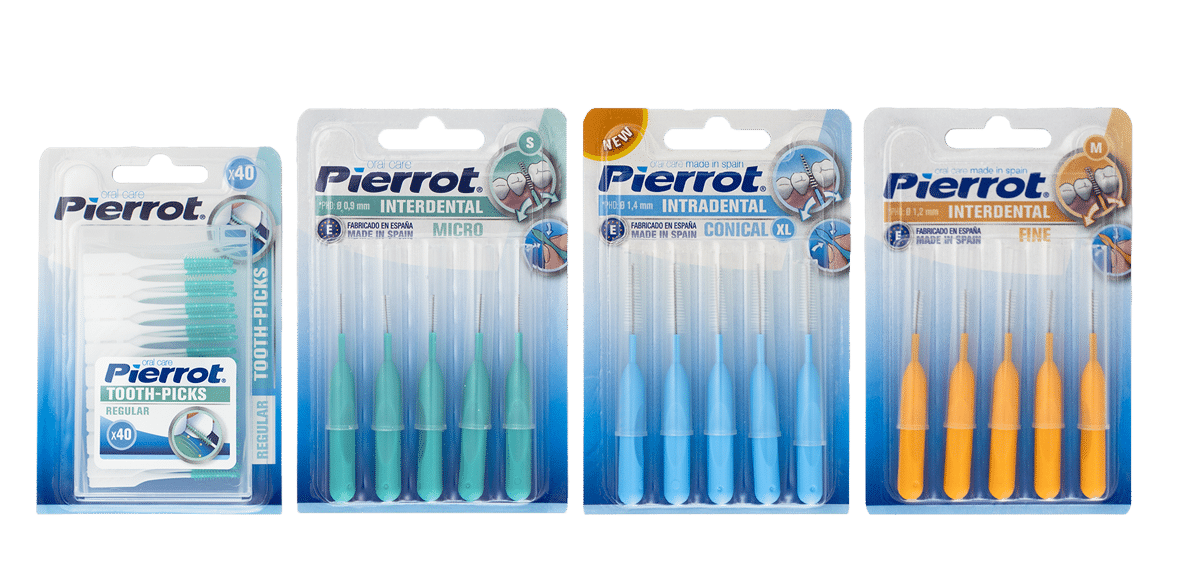
Pierrot interdental brush size chart
The diameter is the passage hole diameter (PHD) shown on the pack: the smallest space the brush fits through.
| Size | Pierrot model | PHD | Suitable for |
|---|---|---|---|
| XS+ | Nano Plus | See pack | 90º neck and non-slip handle |
| XS | Nano | Ø 0.8 mm | Very narrow spaces |
| S | Micro | Ø 0.9 mm | Narrow spaces |
| M | Fine | Ø 1.2 mm | Medium spaces |
| L | Conical | Ø 1.3 mm | Wide spaces; conical shape |
| XL | Conical XL | Ø 1.4 mm | The widest spaces; conical shape |
All of them have a stainless-steel core and a protective cap, and they are sold in packs of 5 brushes. Each size has its own colour, so it can be recognised at a glance.
What size interdental brush do I need?
There is no universal size: it depends on the space between your teeth, and it is normal to need two different sizes, one for the front teeth and another for the molars. The most reliable way to find out is to ask your dentist or hygienist, who can measure it during a visit.
It enters without forcing
The brush should pass through the space without pushing. If the wire bends or it hurts, the size is too large.
It touches the sides
When you move it, you should feel the filaments touching both teeth. If it slides in and out with no resistance, try a larger size.
Start with a fine size
If you do not know your size, start with one of the fine ones, Nano or Micro, and move up only if it feels loose.
Conical or cylindrical
The Nano, Micro and Fine brushes are cylindrical: they clean evenly along their length and are the most common choice for small and medium spaces.
Conical and Conical XL are narrower at the tip than at the base. They enter easily and adapt to wide or irregular spaces.
If you wear braces, an interdental brush also cleans under the archwire: please see what to use with braces.
How to use an interdental brush
- Choose the size Use the one that enters without forcing and touches both teeth.
- Enter straight Insert the brush gently into the space, at gum level and without pressing against the gum.
- Move it back and forth Two or three passes in each space are sufficient.
- Repeat in each space Work around the mouth in order so that no space is missed.
- Rinse the brush Wash it with water after use, let it dry and put the cap back on.
- Replace it in time Change it when the filaments lose their shape or the wire bends.
For very tight spaces, where even the finest size does not fit, dental floss is a better option.
Tooth-picks: rubber picks
Pierrot Tooth-picks are interdental picks with soft rubber filaments and a flexible handle. They remove plaque and food particles between the teeth, and they are a convenient option to carry with you or to start with interdental cleaning.
They are sold in packs of 40, in Regular size.
Where to buy Pierrot interdental brushes
Pierrot does not sell directly to consumers: its products reach the public through the brand’s distributor network. Pierrot is present in more than 60 countries. If you distribute or import oral care products in your market, please see our interdental brushes wholesale page.
You can complete your routine with Pierrot toothbrushes and toothpaste, or browse all Pierrot oral care products.
Frequently asked questions
What size interdental brush do I need?
The one that enters the space without forcing and touches both teeth. You may need different sizes for different areas of the mouth. Your dentist or hygienist can tell you during a visit; if you do not know, start with a fine size.
What interdental brush sizes does Pierrot offer?
Six: Nano Plus (XS+), Nano (XS, Ø 0.8 mm), Micro (S, Ø 0.9 mm), Fine (M, Ø 1.2 mm), Conical (L, Ø 1.3 mm) and Conical XL (XL, Ø 1.4 mm).
Are interdental brushes better than dental floss?
It depends on the space. Where an interdental brush enters without forcing, it is usually easier to use. In very tight spaces, dental floss reaches better. Many people combine the two.
How often should I replace an interdental brush?
When the filaments lose their shape or the wire bends. A worn brush cleans less effectively and may damage the gum.
Can I use an interdental brush with braces?
Yes: it cleans under the archwire and between the brackets. Please see our page on what to use with braces.
Are you a distributor or importer?
Pierrot is looking for distributors in new markets. Please see our interdental brushes wholesale page or request the catalogue.